
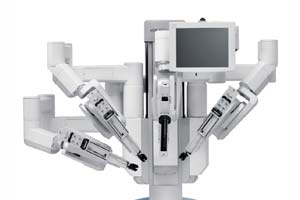
DA VINCI ROBOTIC SURGERY
Written by: Dr. Jonathan Weinstein
For some people hearing that surgery is now being performed by a robot sounds ludicrous. A robot for many people brings up connotations of an autonomous machine not requiring supervision. To apply it to gynecology you would think we could now do a hysterectomy just by pushing a button. In reality, the da Vinci® robot is used to assist surgeons in the use of surgical techniques previously requiring a large surgical incision.
What does this mean for patients? Almost any surgery in the abdomen you are trained to perform as a gynecologist can now be done with more precision, better visualization, improved outcomes and greater patient satisfaction.
We will use hysterectomy, the second most common surgery performed in the United States, as an example of how far we have come as a result of this new advanced technology.
In the beginning, a hysterectomy was performed using a simple knife blade to cut through your abdominal wall, just like a Cesarean Section (C/S), which is the most common surgery performed in the United States. The abdominal hysterectomy (AH) in most cases is a relatively simple operation, relative to say brain surgery, but has some significant drawbacks.
Blood loss can often be significant and lead to anemia and fatigue that usually takes 6-8 weeks to recover from. Often women who have had an abdominal hysterectomy will tell you about at least one of these issues which arose following their surgery: a horrible scar (mainly due to genetics); their wound opened after the surgery making recovery even more difficult and stressful; a loss of sensation around the incision as nerves were cut through to get to the uterus; pain during intercourse or just with moving in a certain direction or position, likely the result of scar tissue inside the abdomen from manipulation of your intestines during the surgery; and any of a number other complications that can occur from surgery.
The big benefit of abdominal hysterectomy is visualization, as you can see everything with your own two eyes through the relatively large incision.
Next came what I consider to be one of the slickest surgeries a gynecologist can perform. The vaginal hysterectomy (VH) is like a magic trick, you go to sleep and wake up with no uterus, no more periods, and no incisions. The drawbacks of vaginal hysterectomy: limited visualization making it more likely injury could occur to surrounding structures, difficulty removing the uterus or ovaries due to unforeseen pathology around the uterus, and still a significant amount of bleeding. Still, vaginal hysterectomy is a significant upgrade from abdominal hysterectomy as you go home the next day and generally are back to feeling yourself in 4 weeks.
Laparoscopic Assisted Vaginal Hysterectomies (LAVH) came next as this allowed the surgeon to place a camera and straight long small instruments through a 1 cm or smaller incision to identify any pathology, release any scar tissue, and cut off the blood supply to the uterus before you proceeded with the vaginal portion of the surgery.
Bleeding was even less than with a vaginal hysterectomy and recovery again was quicker. The main drawbacks of laparoscopic-assisted vaginal hysterectomies were that if dense scar tissue or significant bleeding was encountered in the abdomen you had limited tools at your disposal.
Placing a suture and tying a knot to stop bleeding with straight instruments was slow going at a time when speed was required. Simple movements the human hand could perform such as tying a knot were very difficult, as were precise surgical maneuvers to avoid injury to other structures near the uterus.
The laparoscope (camera) with the insufflation of carbon dioxide in the abdomen allowed for visualization of structures in their exact anatomical position and revolutionized how we performed surgery to remove cysts, an ovary, an appendix, a gallbladder, treat a tubal pregnancy or perform a tubal ligation, while letting the patient go home just a couple of hours after surgery. The majority of the time these patients were back to work in a few days and for many, the next day.
The ideal surgery from the standpoint of a surgeon is one that combines a little bit of each technique: the ability to perform precision surgical maneuvers using your hands, like an abdominal hysterectomy; the elimination of large abdominal incisions like a vaginal hysterectomy; and finally the visualization of the abdominal contents, in their exact anatomical position.
For the patient, the ideal surgery is no surgery, but when medically necessary you want surgery with minimal pain when you wake up, minimal blood loss, the shortest recovery time possible (getting back to that healthy you – ASAP), the shortest hospital stay (saves you money and gets you back in your own house), minimal if any scarring and the instant elimination of the medical problem that led you to require surgery. In gynecology, the da Vinci® surgery method referred to as a ‘robotic-assisted laparoscopic hysterectomy’ is performed with the assistance of a high-tech robot, using laparoscopic incisions or ‘with minimal invasiveness’.
We encourage you to watch the video on this page for more details, but in brief, the da Vinci robot uses laparoscopic articulating instruments that mimic the precise movements the physician’s hands use in performing abdominal and vaginal hysterectomies. The da Vinci camera is high definition, providing a three-dimensional view just like your television and providing unbelievable depth perception. We can see blood vessels a few millimeters in size due to the incredible magnification of the surgical field, a perspective not even an abdominal hysterectomy could provide.
A hysterectomy can now be done with no blood loss. We are able to dissect off an ovarian cyst the size of a grapefruit while leaving the entire ovary intact. Our physicians have removed uteri (plural for uterus) the size of a 24-week size pregnancy with incisions no larger than 1 cm. The majority of gynecologists in the United States are not trained on the da Vinci robot and would have to make a vertical skin incision from the top of your pubic bone to your belly button to remove a uterus this size; you would stay in the hospital for three days and be in a level of pain in many cases equivalent to birthing a baby (no Epidural, of course). In contrast, many of our patients never need anything stronger than Advil.
The da Vinci® robot is not limited in use to hysterectomies; it is used to perform vaginal or uterine prolapse surgery (Sacrocolpopexy), fibroid removal (Myomectomy), clean-up of endometriosis or dense scar tissue causing chronic pelvic pain, severe menstrual cramps and/or bleeding.
If you or someone you know is undergoing an abdominal procedure for any of the aforementioned conditions, we strongly urge you to seek a second opinion. The da Vinci® website will point you in the direction of surgeons who have performed a minimum of 20 cases. The da Vinci® Surgical System by Intuitive Surgical has become the standard for robot-assisted minimally invasive surgical equipment.
Like every service provided at Frisco Women’s Health, we educate you, the patient, about all your options both medical and surgical for whatever condition you may have. Our physicians have trained as da Vinci® surgeons to offer our patients the most minimally invasive surgical options available. A da Vinci® hysterectomy (DVH) does not cost the patient more than any other hysterectomy procedure and is covered by your insurance. We have brochures and patient education DVDs available in the office if you desire additional information.